





Free written scope consultation - allowances, timeline, and change-order rules on paper before a single trade is scheduled
Sakrete Home Additions & ADU: The San Antonio Owner’s Guide
If you’re planning a home addition or ADU in San Antonio and want Sakrete products as part of the foundation or slab work, our crews use Sakrete concrete mixes on the job every week. A full home addition in San Antonio typically runs $45,000 – $130,000, while a detached ADU lands between $90,000 and $220,000 depending on size, site prep, and finishes. Most owners realize their existing slab or foundation is failing when they see cracks open up after a dry summer, doors that stick seasonally, or standing water pooling against the stem wall after a hard Hill Country rain.
You may have bought Sakrete bags for a small pad, a fence post, or a shed floor and now you’re looking at a bigger project. Or the original concrete from the 1980s is spalling and you need to know whether to patch it or pour new. That’s the conversation we have with San Antonio homeowners all the time, and the answer depends on what the concrete is holding up.
Which Sakrete Products This Applies To
We work with the full Sakrete line for home additions and ADUs, but the specific mix matters more than most people expect. Sakrete High-Strength Concrete Mix, the 4000 psi bagged product, is what we spec for interior slabs and non-load-bearing pours. Sakrete Maximizer, their 5500 psi high-strength mix, is the better call for anything that will carry vehicle load or a second story. The difference shows up in the cure and in the long-term resistance to cracking under San Antonio’s clay-heavy soils.
There’s a compatibility gotcha worth knowing: Sakrete’s standard mixes are designed for pours of 2 inches or thicker, but anything under that spreads too thin and won’t bond well to existing concrete. We see DIY pours fail in Leon Valley and Stone Oak when someone tries to feather a 3/4-inch skim coat over an old driveway apron. For thin resurfacing, you need Sakrete Flo-Coat or a polymer-modified product, not standard mix.
If you have a bag from a big-box store, check the manufacturing date printed on the side. Concrete mix older than 12 months can lose a meaningful amount of strength even if the bag was kept dry. We bring fresh material from local San Antonio supply yards on every project, not last season’s clearance pallet.
Styles & brands we work with







Signs Your Sakrete Concrete Work Is Failing
- Cracks wider than 1/8 inch that run edge to edge. Hairline cracks are normal as concrete cures. Cracks you can fit a nickel into usually mean settlement or a slab poured without proper reinforcement. In San Antonio’s expansive clay, this is the most common failure we repair.
- Spalling or flaking on the top 1/4 inch of the slab. This happens when water gets into the surface and freezes, or when the concrete was over-watered at the pour. It’s cosmetic at first, but it opens the door for deeper moisture damage.
- Doors and windows that stick in summer but close fine in winter. That’s the clay soil under your slab expanding and contracting. Your concrete is moving, and over time that movement cracks footings and stem walls.
- Standing water that stays against the foundation for more than an hour after rain. Concrete soaks up water like a sponge. If the grade doesn’t slope away from your addition, the slab is wicking moisture every time it storms, which leads to efflorescence and eventually rebar corrosion.
- A hollow sound when you tap the slab with a hammer. That means the concrete has separated from the base underneath. It’s a warning sign of a void forming, and in San Antonio’s limestone-heavy soil, a void usually gets worse, not better.
See the difference
 Before
 After
After Before
 After
After Before
 After
AfterReplacement Cost & What’s Included
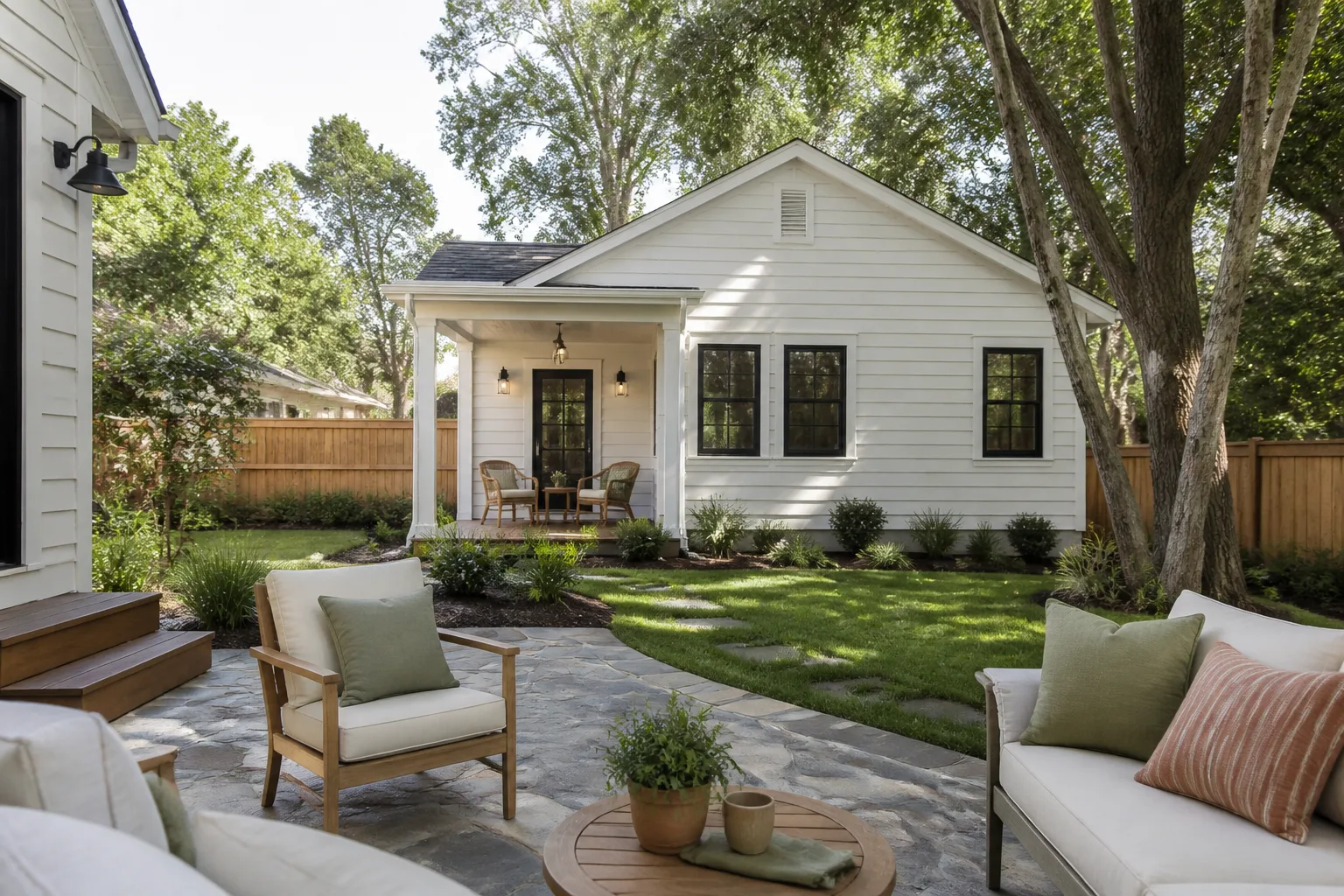
A home addition in San Antonio that uses Sakrete or Sakrete-equivalent concrete for the slab and footings lands between $45,000 and $130,000. A detached ADU runs $90,000 to $220,000. The spread comes down to square footage, how much site prep the ground needs, whether you’re tying into existing plumbing and electrical, and the finish level of the interior.
Every quote we write includes the concrete and forms, rebar or mesh reinforcement, excavation and grading, the vapor barrier, termite pre-treatment if required, and the labor to place and finish the pour. We price it in writing before any work starts, and that written price is what you pay. Graham Stein writes every scope of work down before a single tool leaves the truck, because a concrete project that gets “clarified” after the forms are set is not a project anyone wants to be standing in the middle of.
Our 365-Day Done Right Promise covers the completed work. If the slab cracks beyond what concrete normally does in the first year, we come back and make it right.
DIY or Call Us?
For a bag or two, DIY is reasonable: a mailbox post, a small walkway, a pad for your trash bins. Mix it thick, keep it damp while it cures, and don’t pour over uncompacted soil. But for any slab that will hold a room, a second floor, or a living space, the risks compound fast. Concrete placed wrong can’t be un-poured. Getting the grade right, the forms level, the rebar chaired up off the soil, and the vapor barrier sealed is skilled work, and a failed pour in San Antonio means a jackhammer and a do-over, which costs more than doing it right the first time.
If the project involves cutting into an existing foundation, plumbing under the slab, or structural footings, that is absolutely a licensed contractor’s job. One bad saw cut into a post-tension cable turns a $10,000 slab into a $50,000 structural repair. We’re happy to talk through your project and tell you honestly whether it’s a weekend job or a crew job. Call (432) 233-0976 for a free estimate.
FAQs
A properly poured slab in San Antonio should last 50 to 70 years before major work is needed. The clay soil and our heat cycles shorten that if the pour was under-reinforced or over-watered. We see 1980s slabs in the King William area still holding fine because they were poured thick, while 1990s slabs in newer subdivisions fail early from rushed work. Call (432) 233-0976 if you want us to look at yours, estimates are free.
It depends on the crack. Hairline cracks can be routed and sealed. Cracks that show vertical displacement, meaning one side is higher than the other, usually mean the slab needs section replacement or full replacement. We’ll tell you which one you’re looking at, and we’ll write the answer down before you pay for anything.
The pour itself is usually one day. Excavation, form setting, rebar, and inspection take three to five days before the pour, and then concrete needs 28 days to fully cure before we frame on top of it, though we can walk on it within 48 hours.
We bring fresh Sakrete or comparable spec mix from San Antonio supply yards for every pour. For larger slabs we order from a ready-mix plant, which gives better consistency than bagged mix for anything over a few yards. We don’t store bags on the truck between jobs because concrete degrades in the heat.
Whether you’re adding a bedroom wing, converting a garage, or building a standalone ADU for a parent or a renter, the concrete under it is the part you’ll never see and the part that determines whether the rest of the project holds up. Write it down, price it once, do it right. Call (432) 233-0976 to schedule a walkthrough and get your written estimate.
Written by Graham Stein, Owner, Elmstead Remodeling San Antonio at Elmstead Remodeling San Antonio, serving San Antonio and nearby areas.


